
Nicaragua’s churches were “filled with the faithful” during Holy Week 2026 despite continued governmental restrictions and persecution, according to Father Edwing Román, a Nicaraguan priest in exile in Florida.
“Thousands of Lenten and Holy Week activities were canceled once again — such as group pilgrimages; gatherings where hundreds of the faithful assemble to organize the transport of flowers, religious images, or the cross itself to be carried to the churches in procession, accompanied by music and fireworks; or the ‘Judea’ [the reenactment of the passion of Christ] throughout the country,” the priest told ACI Prensa, the Spanish-language sister service of EWTN News.
In 2022, the dictatorship of Vice President Rosario Murillo and President Daniel Ortega banned processions in the streets and public thoroughfares. “Religious celebrations have been restricted to inside the churches, courtyards, or atriums, under police surveillance,” the priest said.
Holy Week in Nicaragua “was celebrated in an atypical manner” without the religious freedom to do so fully, said Román, who serves as vicar at St. Agatha Parish in Miami. “Thank God, the churches were filled with the faithful of all ages even as they endured the presence of police and infiltrators.”
“People attended the Easter Vigil in Nicaragua’s parishes under police surveillance. They take photos and videos of the people entering and leaving the church,” Martha Patricia Molina, author of “Nicaragua: A Persecuted Church” reported on X.
“Sandinista guards were present to harass the Procession of the Encounter [which depicts the risen Christ appearing to his mother Mary] at a parish in the Archdiocese of Managua,” she also reported on X.
Despite the restrictions, however, Román emphasized that “thousands of the faithful attended churches even with the regime’s extensive propaganda urging people to visit the country’s beaches and tourist centers, the majority of which are owned by Sandinistas — that is, individuals aligned with the dictatorship.”
On March 31, Christopher Landau, U.S. Deputy Secretary of State, denounced the Nicaraguan dictatorship for banning public Holy Week processions and expressed his hope to see “the day when our Nicaraguan friends reclaim their religious freedom.”
Responding to Landau, the Nicaraguan government published a statement titled “Utterly False,” in which it “categorically refutes the perverse accusations issued by U.S. government spokespersons” regarding religious activities during Holy Week.
The regime countered that “throughout Nicaragua, thousands of religious activities — both Catholic and those of Christian and evangelical churches — are taking place.”
However, the statement did not specify that the regime banned public Holy Week activities. If any do take place in defiance of the government, they are dispersed by the police.
Molina told ACI Prensa that since 2019, the dictatorship has banned more than 28,900 public processions and acts of popular piety.
Another exiled priest consulted by ACI Prensa who preferred to remain anonymous out of fear of the dictatorship, noted the extensive coverage given to Holy Week activities by media outlets aligned with the regime.
“This year, an unusually large number of media outlets provided coverage,” he said. “I interpret this as stemming more from the government’s fear regarding the current situation and the sanctions involving Venezuela, Cuba, and Iran.”
Román noted the media presence as well, saying that “ironically, pro-government media outlets made their presence felt — going so far as to climb onto the high altar in the midst of a service — to take photographs inside the churches for their political propaganda, thereby denying the existence of any prohibitions and asserting, as they did in a recent statement, that everything is ‘normal.’”
A third exiled priest who also wished to remain anonymous noted that there was no chrism Mass in the dioceses whose bishops have been exiled, nor were there public processions. However, the faithful managed to organize them nonetheless, “with the creativity of the people of God.”
Four Nicaraguan dioceses are currently led by bishops living in exile and lack their shepherds’ physical presence in the country: Matagalpa and Estelí, headed by Bishop Rolando Álvarez (who resides in Rome); Siuna, led by Bishop Isidoro Mora; and Jinotega, led by Bishop Carlos Herrera, who is exiled in Guatemala.
Alongside Pope Leo XIV, Álvarez, who was formerly imprisoned by the Ortega dictatorship, participated in the Rite of the Adoration of the Cross at the Vatican during Holy Week.
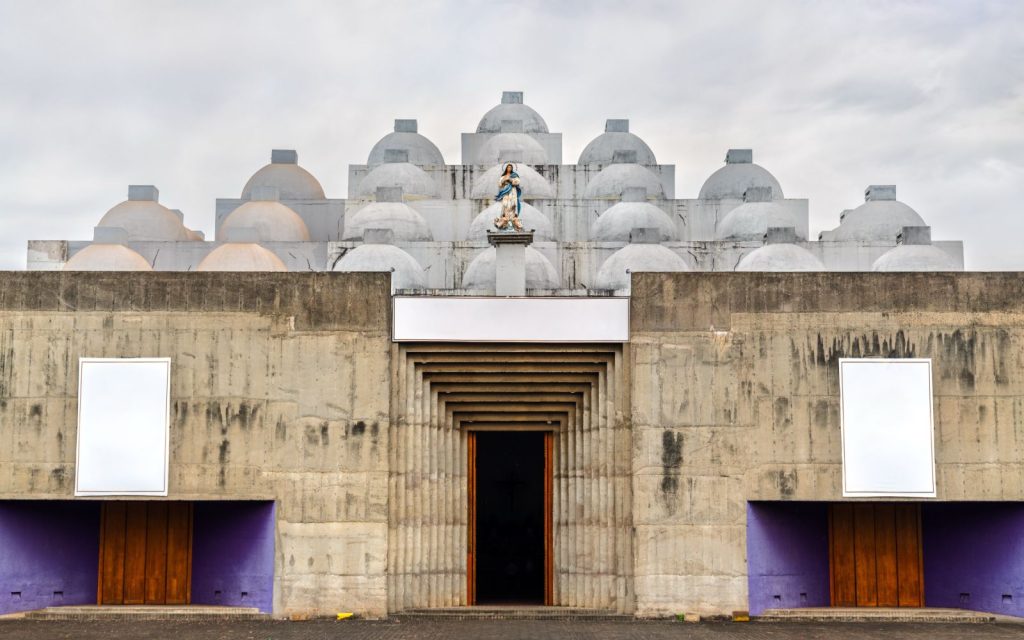
On Holy Thursday, at the conclusion of the chrism Mass at the Managua Cathedral, Cardinal Leopoldo Brenes told the media present inside the church that bishops throughout the country sent him images “showing the level of participation in their cathedrals, as well as in their parishes.”
He continued: “What we observe here is the tremendous work of the priests, and that the people — with complete generosity and absolute freedom — have been able to come to their churches and are living out their faith, which, I believe, is the most important thing.”
Brenes, the metropolitan archbishop of Managua, led the Good Friday Stations of the Cross at the Managua Cathedral, which lasted over four hours and drew thousands of the faithful to the surrounding grounds.
Bishop Báez’s homily on Easter Sunday
Silvio Báez, the auxiliary bishop of Managua, has lived in exile since 2019, celebrated midday Mass on Easter Sunday at St. Agatha Parish in Miami. He noted that “by raising the Crucified One from the dead, God reveals not only the triumph of his power over the destructive power of death but also the victory of his justice over the injustices of men.”
“The new hope that Jesus introduces into the world can only be proclaimed out of faith in a God who does not abandon the victims — a liberating God who does not accommodate the pretensions of the powerful, nor follow the paths laid out by the masters of the world. In the presence of the risen Lord, we must ask ourselves whose side we are on: that of those who crucify, or that of the crucified?” he asked.
This story was first published by ACI Prensa, the Spanish-language sister service of EWTN News. It has been translated and adapted by EWTN News English.