Beauty Just Might Save the World

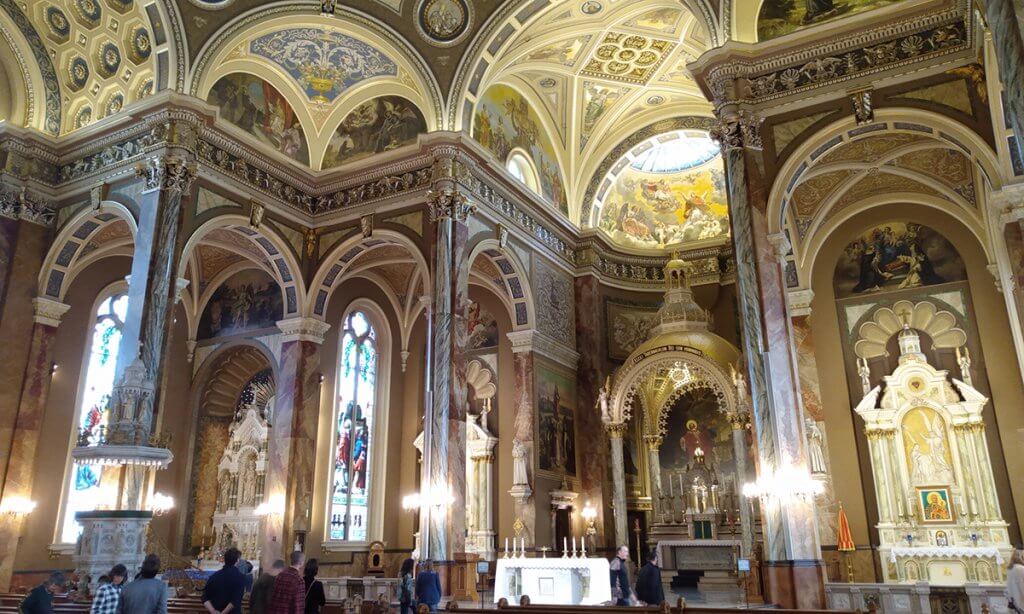
The Basilica of St. Josaphat in Milwaukee might be the most beautiful church in America. I’m no expert—and I certainly haven’t seen every church in the country—but it’s hard to imagine it has much competition.
The Basilica is run by the Conventual Franciscans, one of whose priests gave me a tour about a decade ago, and he said something I’ll never forget:
“The world has done away with truth and goodness, but beauty… beauty is something the world hasn’t figured out how to get rid of. Even if an atheist walks into this Basilica, his jaw drops open and his eyes turn to heaven.”
I grew up during the death of truth and goodness.
The attacks began long before my formative years, but I vividly remember hearing “Who am I to judge?” and “That’s your truth” in my teens and twenties.
If truth, goodness, and beauty always point us toward God, it’s no surprise the world wants to do away with all three.
Relativism is a direct attack on truth and goodness. What’s true for you might not be true for me. “I’m living my truth.” If you aren’t hurting anyone, do whatever you want. We’ve all heard some version of it. And the underlying lie is that there is no truth at all.
The world tried to kill truth to stop us from finding God.
The world tried to kill goodness to stop us from seeing God in ourselves and one another.
But beauty is different. Beauty doesn’t argue. You can debate a claim about truth or goodness, but beauty reaches the heart before the mind can object. Music, painting, poetry… the arts stir something deeper than the senses.
So, how does the world attack beauty?
Counterfeit. If you can’t kill it, fake it.
What once required the creative power of a human being can now be thrown together by artificial intelligence. A movie. A poem. A painting. Even an article for a Catholic diocesan magazine can be produced with the click of a button (I promise, no AI here).
But AI is only an imitation of intelligence, and it can only produce an imitation of beauty. The Vatican’s document on AI, Antiqua et Nova, reminds us of the artisan who can see in raw material a form no one else recognizes and the friend who knows exactly the right word to say. Some things simply can’t be faked. As Pope Francis put it, “Poetry and love are necessary to save our humanity.”
That won’t stop the world from trying.
I grew up while truth and goodness were under attack. Now, I’m raising kids in a world coming after beauty.
Endless streaming content. Enough YouTube videos to fill a hundred thousand lifetimes. AI slop.
The world isn’t claiming beauty doesn’t exist, the way it did with truth and goodness. It’s making counterfeit beauty so easy, so quick, so effortless that young people can’t tell the difference anymore.
This endless stream of “content” sure is stimulating… but it’s not beauty. It’s not wonder. It’s not awe.
Endless streaming is stimulating, but it leaves you drained.
Beauty like a Basilica is wonderful, and it fills you up.
This is where our Catholic schools come in. Outside the home, this is where young people learn the power of creating. Not for attention. Not for content or algorithms or becoming YouTube famous. My favorite author, Kurt Vonnegut, said that practicing an art, no matter how well or badly, is “a way to make your soul grow, for heaven’s sake.” Sing in the shower. Tell stories. Write a lousy poem for a friend. You will have created something.
So go make something. The counterfeit beauty the world casts into our laps is passive. You just take it in, repeatedly. Your kid’s lump of clay that was supposed to be a St. Joseph statue is doing more for his soul than another YouTube video ever will. The hymn sung in choir is worth more than a thousand auto-tuned karaoke apps.
School starts this month. It’s a great time to get back to creating instead of consuming.
Take your kids to the art museum. Go watch the ballet. Visit the Cincinnati Symphony Orchestra.
Or just put on a puppet show in your living room.
Because beauty just might be the one thing the world can’t kill. And as long as we keep showing our kids the difference between the real thing and the counterfeit, we can have great hope for the next generation.
More By This Author
- Dominick Albano
- Dominick Albano
- Dominick Albano

Subscribe to the Ember
Weekly news from around the Archdiocese
Stay connected to our vibrant Catholic community! Sign up to receive our weekly digital newsletter The Ember. We’ll keep you informed and inspired with local news, fellowship opportunities, and event reminders.