
A Hidden Life —Terrence Malick’s Cathedral on Film

In Catholic circles, some movies and series are held in such high esteem that they are essentially considered “required viewing.” Among these are Lord of the Rings, It’s A Wonderful Life, A Man for All Seasons, and The Passion of the Christ. Another film that should be added to this pantheon of artistic giants is Terrence Malick’s 2019 film, A Hidden Life. Among the treasured company, this masterpiece is every bit as true and good (and even more beautiful).
The movie explores the life of an Austrian conscientious objector in World War II, a devout Catholic man named Franz Jagerstatter who peacefully defied Nazi orders. He was a man who, much like St. Thomas More, had much to live for—he had a beautiful family, a loving wife, and an idyllic property in the Austrian countryside. At the same time, he felt Christ’s ultimate calling and knew that his soul could not rest if he joined forces with something he knew was evil. Christ Himself tells us, “Whoever loves son or daughter more than me is not worthy of me; and whoever does not take up his cross and follow after me is not worthy of me” (Mt 10:37-38).
As with all great examples of Catholic art, A Hidden Life completely employs goodness, truth, and beauty to tell its story and give viewers a transcendent experience: love for the Divine is fully on display. Franz and his prayerful family are often seen contemplating the Cross, even (and especially) while the foreboding presence of evil is advancing on their serene dwelling. He is a good man worth knowing about, and Malick’s film helps us get to know him and, perhaps, internalize his struggle.
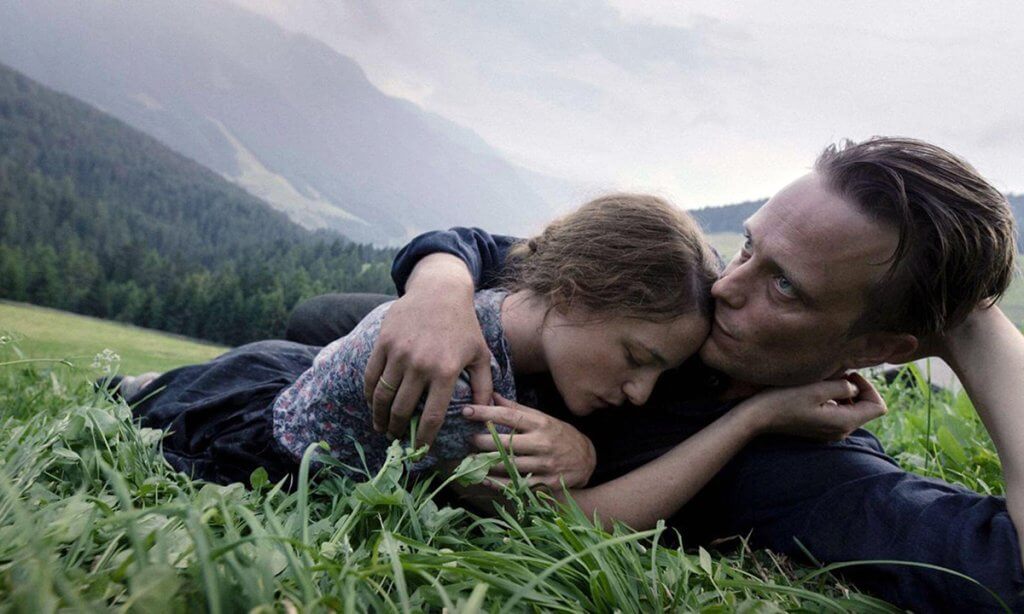
Bishop Robert Barron describes beauty as “the arrowhead of evangelization” for its ability to charm and delight a person beyond words. Beauty in art can leave one speechless; it can direct one’s gaze upward and outside of oneself. From an egocentric starting point, we find ourselves suddenly in a theocentric place when the beauty of sacred art or God’s wonderful creation captures and mystifies us. A Hidden Life has perhaps the most striking natural beauty ever captured in a mainstream movie. The camera, in its fluid dance, weaves and meanders across the gorgeous Austrian countryside, perfectly juxtaposing the bucolic perfection on display in the wilderness against the cold and angular brutality of the Nazi encampments.
Indeed, this movie is like a cathedral in the way that its beauty can leave viewers completely spellbound, much like The Sound of Music did with similar landscapes many years ago. Malick clearly understands that these visuals connect with Franz’s love for God, as the perfection in creation always reflects the Creator—“For from the greatness and beauty of created things comes a corresponding perception of their creator” (Wis 13:5). Quite literally, the positioning of the camera often points the viewer skyward, as Malick sets cameras very low to the ground to gaze upward at the characters and the surrounding vistas.
This type of feast for the senses requires patient, thoughtful viewing, and the pacing of this movie accentuates this. It is a breath of fresh air to have a movie that lets scenes breathe, so that we can take it all in, unlike so many blockbusters today that rapidly cut between scenes to both stimulate the viewer and simulate intense action. Movies are meant to be a delightful escape from everyday life, but shouldn’t those two hours we spend watching them bring us out of ourselves and make us ponder something greater? Whether that be Christ specifically or any number of other explorations of truth as told from a secular perspective, we can see that escapism without psychological depth is no more enriching than, as Martin Scorsese once put it, “an amusement park thrill ride.”
Witnessing beauty feeds our soul in ways that we sometimes don’t realize we need until we’ve been starved of it. The purpose of Brutalist architecture, for example, devilishly seems to acknowledge this fact, as its coldness and blank indifference seeks to make humans fall in line—ordering them toward a purely human servitude rather than the Divine servitude that is begged by the beauty in every magnificent European cathedral. These are pieces of art that people from every nation, creed, and background come to see, and their spirits soar at the grandeur of the masterpiece.
Let A Hidden Life into your home as soon as you can, and perhaps you will find it to be a cathedral on film. Its beauty will enrich you, its goodness will inspire you, and its truth will draw you out of yourself to something infinitely more fulfilling.

Subscribe to the Ember
Weekly news from around the Archdiocese
Stay connected to our vibrant Catholic community! Sign up to receive our weekly digital newsletter The Ember. We’ll keep you informed and inspired with local news, fellowship opportunities, and event reminders.