
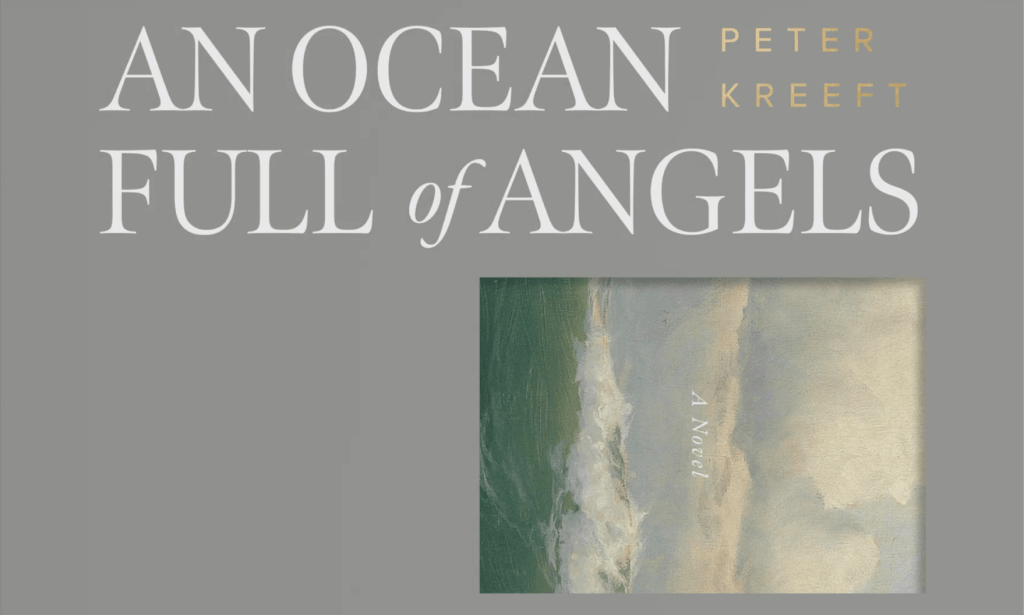
An Ocean Full of Angels, a Novel by Peter Kreeft

An Ocean Full of Angels by Peter Kreeft | Word on Fire Luminor, 2026 | 432 pages | $34.95
Of all living writers, Peter Kreeft is the one who reminds me most of C. S. Lewis. Like Lewis, Dr. Kreeft has an uncanny ability to put the most abstract and abstruse philosophical and theological concepts into language that anyone can understand. This is the reason that he is one of the most popular and powerful Christian apologists of our day, emulating Lewis’ own perennial popularity and powerful witness.
With the publication of An Ocean Full of Angels, Kreeft proves that he can emulate Lewis in writing great apologetic fiction, as well as non-fiction. This might come as a surprise. Lewis was a literature professor; Kreeft is a professor of philosophy. Might we not expect him to be out of his depth, or at least outside his comfort zone? Perhaps so. But Lewis wrote The Problem of Pain and Miracles, both works of philosophy. If the literature professor can successfully dabble in philosophy, might not the philosopher successfully dabble in fiction? The answer, at least in the case of An Ocean Full of Angels, is a resounding yes!
Although this is Kreeft’s first novel, it does not bear the telltale hallmarks of the novice. On the contrary, it has integrity in its entirety, which is to say that each character and plot line, every detail, serves the whole. Continuing the comparison with Lewis, it reminds me of Lewis’ last and best novel, Till We Have Faces, in which Lewis grapples with the rival claims of religious faith and philosophical reason. Kreeft’s principal protagonists are a young, devout Muslim man and an equally young and equally devout Jewish woman. Like a latter-day Romeo and Juliet, these young folks, ostensible enemies, become “lovers.” Unlike Shakespeare’s lovers, however, who abandon reason in pursuit of passion, Kreeft’s lovers do not permit the heart’s longing to lead to a headlong descent into heedless and headless self-destructiveness. Both are on a pilgrimage in pursuit of ultimate union with divine truth.
Kreeft adroitly handles the interaction between the faith traditions of Judaism, Christianity, and Islam. A resolute and indefatigable defender of truth, he doesn’t succumb to the ecumenism that seeks to eliminate religious differences by embracing relativism. On the contrary, Kreeft follows the approach of Lewis’ Mere Christianity in which the lowest common denominator of relativist “ecumenism” is spurned in favor of the highest common factor between the faith traditions.
Ultimately, union can only come with communion in Christ. Although this is clear from the trajectory in An Ocean Full of Angels, it is followed without preachiness and without facile dismissal of non-Christian belief. Instead, the principal characters, irrespective of their theological starting points, or their predilections and prejudices, are invited, in the words of Aslan in The Last Battle, to venture “further up” and “further in.” More to the point, the reader is also invited to venture further up and further into the divine mystery of God’s divine mastery.
Of all the novels written this century that I have read, and I have read many, this stands alongside the best. I might even suggest that only Laurus by Eugene Vodolazkin is its superior. Considering that it’s safe to prophesy that Vodolazkin’s masterpiece is destined to be a canonized classic, this is about as high a praise as I can give to Kreeft’s own literary tour de force.

Subscribe to the Ember
Weekly news from around the Archdiocese
Stay connected to our vibrant Catholic community! Sign up to receive our weekly digital newsletter The Ember. We’ll keep you informed and inspired with local news, fellowship opportunities, and event reminders.