
What remains of Archbishop John Baptist Purcell’s life survives in fragments of brittle letters, handwritten ledgers, and the early pages of The Catholic Telegraph. Gathered together, they reveal not just a figure from the past, but a man constantly at work: writing, building, teaching, and defending a growing Catholic community in an often-hostile city.
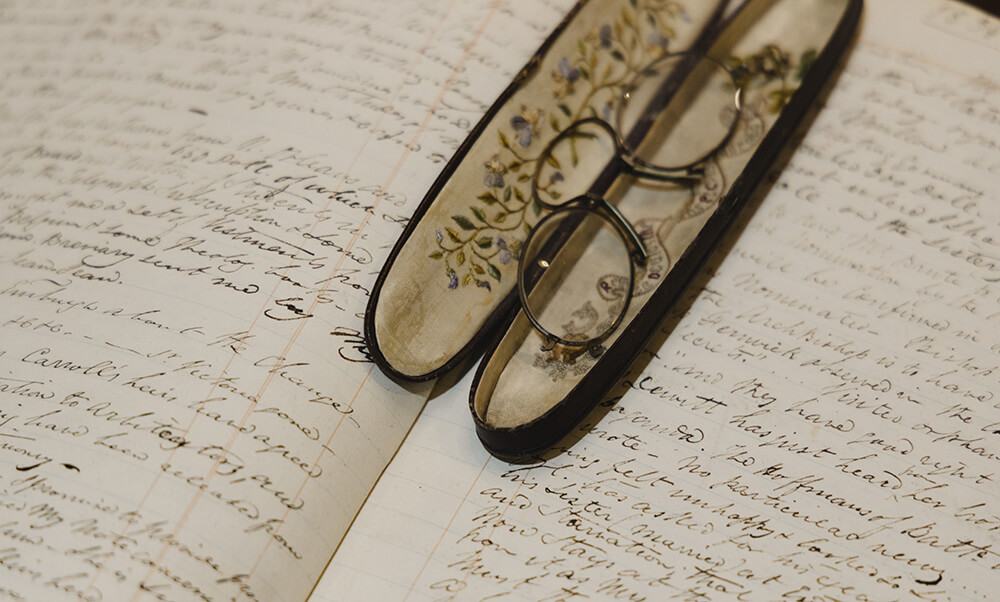
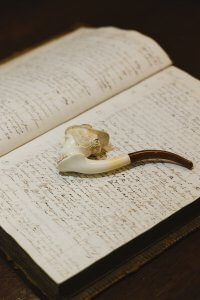
The records also reveal something quieter and more enduring; they suggest that Purcell understood the daily labor of a bishop, like any honest work, as something worth being offered to God. This conviction is visible both in Purcell’s words and the ordinary objects he left behind: his journal from the 1830s, pair of glasses, gardening hat, and smoking pipes.
The journal itself, kept from 1833 to 1836, is modest in size and practical in tone. Purcell records observations, plans, and concerns of a young diocese still finding its footing. Writing for a successor he assumed would come soon was an act of trust, a quiet acknowledgment that the Church belonged not to him, but to God. His careful planning became a form of prayer, rooted in humility and hope.
The journal carries an unintended irony. When Purcell set pen to paper, he could not have known that he would lead the Church in Cincinnati for fifty years, one of the longest episcopal tenures in U.S. Catholic history. Born in Mallow, County Cork, Ireland, Purcell himself had arrived in Cincinnati as an immigrant, and he would shepherd an archdiocese whose rapid growth was fueled in large part by successive waves of newcomers, whose faith and labor brought vitality to the Church.
In a young nation still finding its identity, being Catholic was often difficult and unpopular. Yet Purcell persevered, standing with his people and helping the Church take root. Many Catholic families today can trace their roots to those same immigrants of his time, who arrived seeking opportunity, only to encounter deep suspicion and open prejudice.
Perhaps the most striking items in the archives are the simplest ones. Purcell’s pipes, glasses, and gardening hat bear the marks of ordinary use. They remind us that even archbishops live embodied human lives; reading, tending the soil, pausing for rest. These humble objects strip away titles and accomplishments and reveal a man shaped by the rhythms of work and prayer familiar to us all.
The future of the Church, like its past, will be built not only through grand moments, but through faithful daily work. Purcell’s life reminds us that holiness is not separate from our labor, but grows within it, when work and prayer are patiently woven together, day after day.
Growth under Archbishop Purcell
Purcell starts in 1833: 16 churches, 7,000 Catholics, 14 priests
Purcell dies in 1883: 500 churches, 500,000 Catholics, 480 priests
Religious Orders Introduced:
- Men (9): Jesuits, Franciscans, Lazarists, Fathers of the Precious Blood, Passionists, Fathers of the Holy Cross, Fathers of the Holy Ghost, Brothers of Mary, Brothers of the Poor of St. Francis
- Women (10): Sisters of Notre Dame of Namur & of Muelhausen, Sisters of the Precious Blood, Ursulines, Sisters of the Good Shepherd, Sisters of Mercy, Sisters of the Poor of St. Francis, Little Sisters of the Poor, Ladies of the Sacred Heart, Sisters of the Third Order Regular of St. Francis, Sisters of Charity.
 .
. 
This article appeared in the March 2026 edition of The Catholic Telegraph Magazine.