
Origins
Formed in 1916 with 40 families, mostly German, who previously worshipped at St. William, St. Teresa of Avila was an “English” parish with no ethnic affiliation. Fr. Joseph B. Mueller, then pastor of St. Louis Church in downtown Cincinnati, was named pastor and worked to grow the church and neighborhood – he was instrumental in bringing the Warsaw Ave. Extension to the city’s streetcar system. When he died in 1939, St. Teresa was on its way to becoming one of the archdiocese’s biggest parishes.
Through the Years
1916
First Mass celebrated at a home on Overlook Ave. Church built in 21 days by parishioners and designed in a Spanish Mission revival style by parishioner Anthony Kunz, Jr., an architect who also designed Elder High School, St. Francis Seraph, and other notable buildings. The style was inspired by his visit to the Panama- California Exposition in San Diego.
1918
School built, staffed by Sisters of Mercy.
1922
Combined school/church built in the same style and designed by the same architect. The old church, currently used for storage and meeting space, is slated for renovation.
1935
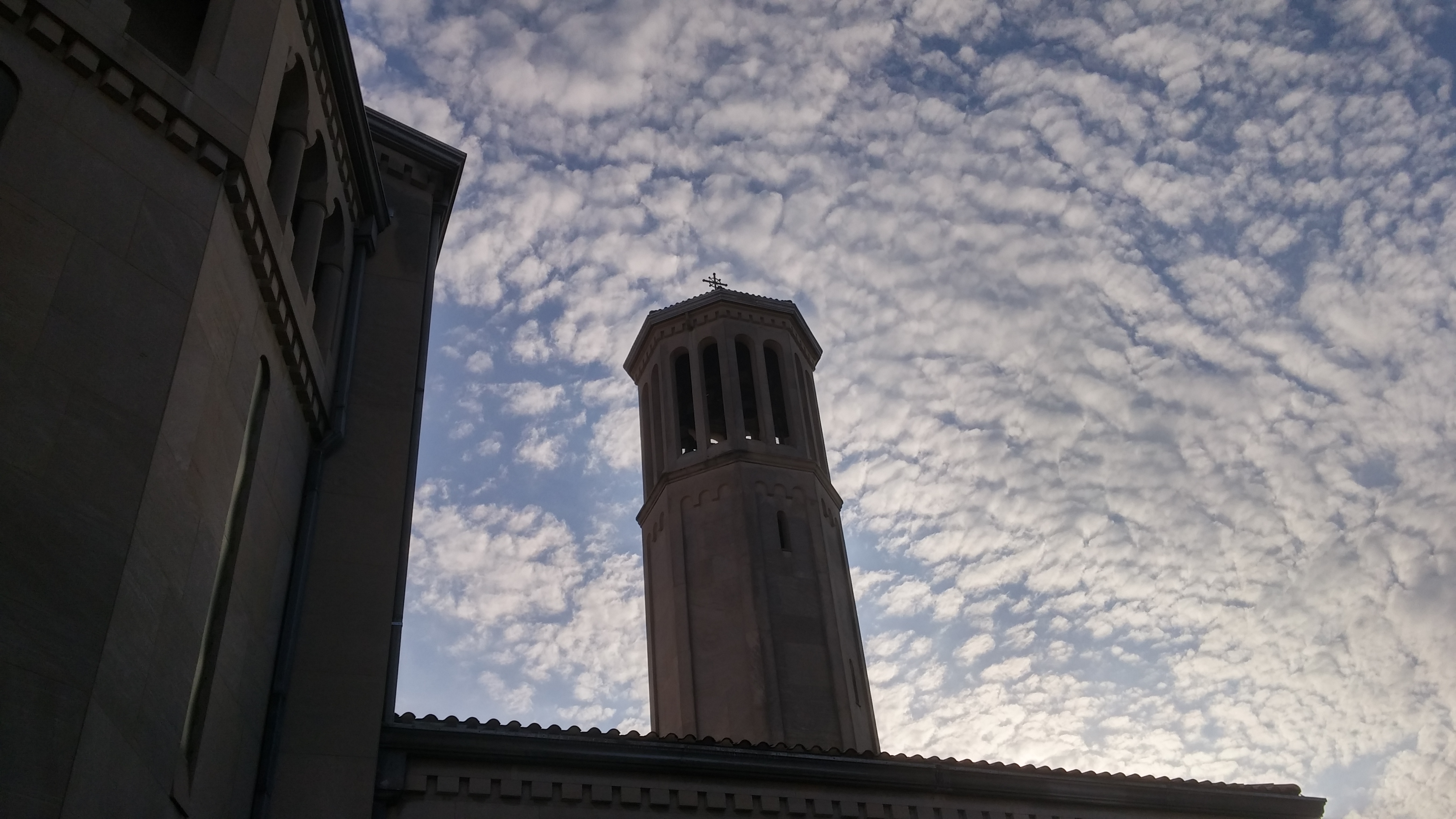
School students raise funds to buy, install, and electrify the replaced bells from St. Peter in Chains Cathedral.
1939
First annual Corpus Christi Eucharistic procession through the streets. This practice lasted until the 70s, revived in 1998, and is now a joint procession with St. William Parish.
1941
School addition doubles building’s size.
1960
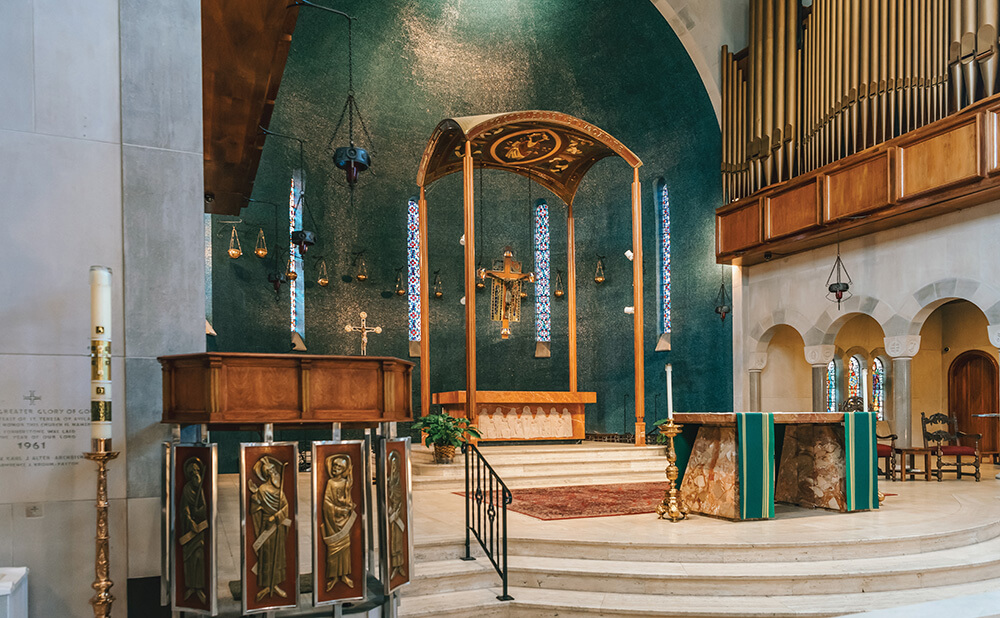
Ground broken for current church. Pastor Msgr. William Anthony, and architect John Burdick from Otto Baier Nilsen, toured Europe together for design ideas. The eclectic style features a Romanesque revival interior with primitive Spanish touches; a façade based on the Church of St. Gilles-du-Gard, Arles; triple prophet- and-saint window sets based on the world’s oldest surviving stained glass (at Augsburg Cathedral in Bavaria), made by Franz Meyer Co., Munich; and exterior sculptures and friezes made by Robert Koepnich, head of sculpture at the Dayton Art Institute, and student Walter Driesbach.
1962
Held first Mass in the new church’s lower level and, on Christmas, the first Mass in the main church. The tabernacle moved to the side chapel in 1970. New, freestanding altar purchased from a closed school in 1972.
2013
Major church renovation and restoration begins. Students vote on saints to feature in new windows made by Architectural Art Glass, Milford, to match the original windows. New altar furnishings, using existing bas reliefs, made by parishioner Tim Jansen.
By the Numbers
1,200 | The first recorded donation for the original 1888 church, from a boy who contributed all his savings.
100 ft. | Bell tower’s height
75 | Relics in the reliquary, including a piece of the True Cross.
1 | Statue of St. Teresa made by Spanish sculptor Nassio Bayari Lluch of Valencia, Spain, while he studied in Cincinnati.
Quotes
“The priest who designed this went around Europe looking at buildings for ideas and brought them all together—it’s a really good way to make a mishmash, but here they come together beautifully. My favorite piece of art is the statue of St. Joseph—it’s a moving look at Christ as a child and Joseph as a loving father.” —Fr. Zachary Cecil, pastor
“The priest who designed this went around Europe looking at buildings for ideas and brought them all together—it’s a really good way to make a mishmash, but here they come together beautifully. My favorite piece of art is the statue of St. Joseph—it’s a moving look at Christ as a child and Joseph as a loving father.” —Fr. Zachary Cecil, pastor
This article appeared in the October 2025 edition of The Catholic Telegraph Magazine.